Key concept:Falling in love is much more than you think.
HI ,
You know that electric moment. Your heart flips, the room brightens, and suddenly this person feels like the answer to a question you didn’t know you’d been asking your whole life. They laugh too loudly, speak their mind without apology, cry openly, or chase dreams with a courage you secretly envy. And in that instant you think, They’re the part of me I lost somewhere along the
way.
That thrill isn’t random. Three brilliant psychologists—Eric Berne, Carl Rogers, and John Bradshaw—spent decades studying exactly why love feels like coming home to a missing half. Their insights fit together like puzzle pieces, revealing that the excitement of falling in love is often your psyche’s loudest invitation: Here’s your chance to become whole again.
The Script You Didn’t Know You Were Following
Eric Berne, the creator of Transactional Analysis, saw relationships as a stage where we unconsciously replay childhood “scripts.” From a very young age we learn which parts of ourselves win love and which parts get us scolded, ignored, or shamed. We tuck the “unacceptable” pieces away—maybe your playful silliness, your anger, your need for adventure—and lock them in a mental box labeled “Not
Allowed.”
When someone new walks in and freely expresses exactly those locked-away traits, your Child ego state (the playful, emotional part of you) lights up like fireworks. It feels magical because, for the first time in years, you’re getting “strokes”—warm recognition—for the whole you, not the edited version.
But Berne warned that many of us don’t stop at simple joy. We slide into hidden “games”: little unconscious dramas like “If It Weren’t For You” (blaming the partner for our own lost freedom) or “Uproar” (starting fights to avoid real closeness). The excitement is real, but the script is old. The partner isn’t just attractive—they’re temporarily playing the role of the
free, spontaneous self we were forced to abandon.
The Safety to Be Real Again
Carl Rogers took Berne’s ideas and added profound hope. He believed every human has an inner drive toward “self-actualization”—becoming the fullest, most authentic version of ourselves. The problem is that most of us build a “false self” to win approval: we hide the parts that once got us rejected.
Rogers discovered that real growth happens only when someone offers us unconditional positive regard—total acceptance with zero strings attached. When you fall in love with someone who naturally lives the qualities you buried (maybe they’re boldly creative while you learned to play it safe), their acceptance gives you permission to drop the mask. Suddenly you feel safe to laugh louder, speak
your truth, or chase that dream you shelved at age twelve.
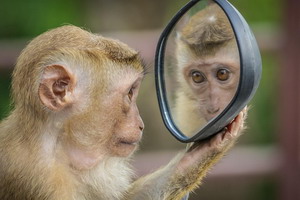
The rush you feel? It’s your real self stretching its arms after years in a cage. Rogers called this the ideal relationship: two people becoming more themselves because they’re truly seen. The beloved isn’t completing you—they’re holding up a mirror that says, “It’s safe to be all of you now.”
The Wounded Child Who
Recognizes Home
John Bradshaw went deeper still, straight into the pain. Many of us carry “toxic shame”—the quiet belief that something inside us is fundamentally broken. That shame splits us: we exile the tender, angry, playful, or needy parts of ourselves and pretend they don’t exist.
When the right person appears, something astonishing happens. The honeymoon phase triggers an almost baby-like state of fusion—gazing, baby-talk, that “we’re one person” feeling. Bradshaw called it a temporary return to the perfect safety we once had (or desperately wanted) as infants. The partner seems to carry the exact energy we lost: the freedom, the joy, the confidence. Your wounded inner child recognizes
them instantly and thinks, Finally—someone who can love the parts of me that were never loved.
The excitement is intoxicating because, for a little while, the shame disappears. You feel whole. But Bradshaw was clear: this is both a golden opportunity and a trap. If you don’t do the inner work, the relationship eventually replays the old wound. The partner stops feeling like your missing half and starts feeling like the parent who once rejected you. He called
the crash “Post-Romantic Stress Disorder.”
Putting the Three Together: The Mirror That Heals Here’s where the ideas click into one beautiful picture:
Berne shows you the script: you’re attracted because the other person is acting out the role you were told to abandon.
Rogers shows you the safety: their unconditional acceptance invites you to reclaim that role for yourself.
Bradshaw
shows you the wound: the intensity comes from your inner child finally seeing its lost twin—and the healing only begins when you stop asking the partner to carry your exiled parts forever.
The person you fall for really does feel like the half of yourself you lost. They model the freedom to feel, speak, play, or dare in ways you were taught to suppress. Your brain floods with dopamine because wholeness is the ultimate reward. Ancient myths (Plato’s split humans) and depth psychologists (Jung’s anima/animus) described the same phenomenon centuries ago. Modern research simply gave it names and road
maps.
But here’s the liberating twist all three psychologists agree on: the goal isn’t to keep the partner locked in the “missing half” role forever. That’s the trap. The real magic happens when you thank them for the mirror, then turn it inward. You start expressing those repressed qualities yourself. You become playful, bold, tender, or courageous—not because they’re doing it for you, but because you finally give
yourself the unconditional positive regard Rogers described and heal the inner child Bradshaw taught us to nurture.
Making the Magic Last So what does this mean for real life?
Notice the spark honestly. Ask yourself: What part of me is this person freely living that I learned to hide? That single question turns infatuation into self-discovery.
Enjoy the honeymoon fully—but don’t build your identity on it. The chemicals will fade; that’s
normal.
Do the inner work. Talk to your younger self. Grieve the parts that were shamed. Practice the qualities you admired in your partner until they belong to you again.
Offer the same gift back. Give your partner unconditional acceptance too. Watch both of you grow into bigger, freer versions of yourselves.
Love that follows this path doesn’t just feel exciting—it transforms you. The person who once seemed like your missing half becomes your teammate on the journey toward wholeness. And the relationship stops being about completing each other and starts being about two complete people choosing to walk side by side.
The next time your heart does that ridiculous flip, smile and whisper a quiet thank-you—to the person in front of you, and to the brave, beautiful, long-buried parts of yourself that just woke up and said hello.
They weren’t lost forever. They were only waiting for permission to come home.
Take care,
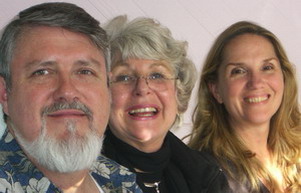
David
Ellen
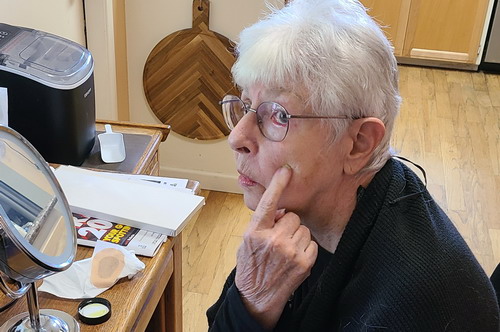
We are starting to engage in our normal life again. Ellen is feeling well enough to think about things other than her hip pain. Last week she wanted me to make up an herbal salve called "No More tears" that she was introduced to by Linda, a former employee. Ellen had the recipe, which entailed soaking a bunch of different herbs in hot coconut oil for three days then turning the final herbal extract into a cream. Here
she is testing it out on facial spots she wants to correct. She says it is a great salve and wants to know its limitations before recommending it to others.
High meat consumption reduces dementia for APOE4 carriers
APOE4 gene carriers are much more likely to develop dementia than the average population. However this new study demonstrates that this trend reverses if these folks eat a high meat diet. Consuming 125 grams (about 1/4 lb) of meat daily prevented them from developing dementia.
"Life is a mirror of us. Our attention is drawn to reflections of ourselves. Attraction or negative judgments are reflections of our feelings of ourselves.
What we see outside ourselves is only a reflection of how we experience ourselves on a feeling level inside."
~David DeLapp
_____________________________________
Walking pace better than blood pressure or cholesterol for predicting mortality
Analyzing the records of over 400,000 folks, researchers found that your walking pace was a better measure of your chances of bad health outcomes than the more commonly used metrics. When they included leisure time activity, grip strength, and sleep duration the results were even better.
"You are loved for how you participate with others, not for who you are. Who you are on the inside is invisible to others. Our insides are mostly invisible even to ourselves."
~David DeLapp
________________________________________
Binge eating caused by highly processed foods
Binge eating started first being noticed back in the 70's, about the same time super yummy highly processed foods were created. Notice you never hear of anyone binge eating broccoli.
"Principle of active hope. Active hope recognizes the constantly changeable nature of reality and works today for a better tomorrow. Passive hope just wishes to be given a better tomorrow without work. "
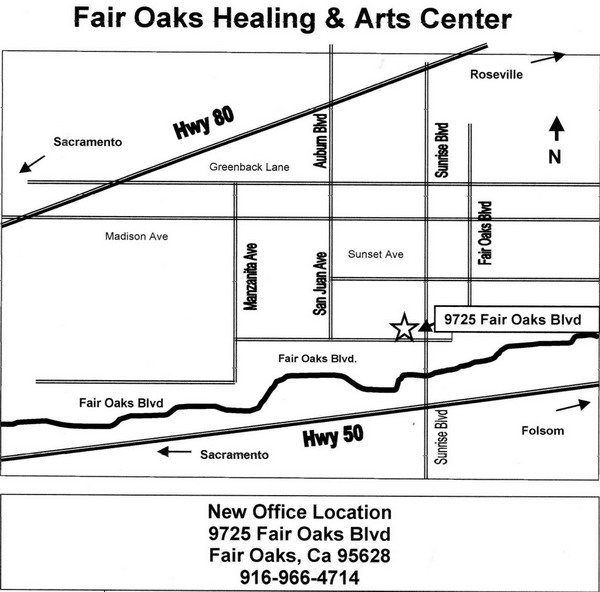
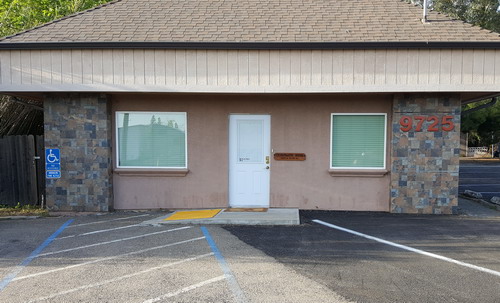
Our address is 9725 Fair Oaks Blvd. suite A Our hours are M, Tu, Th, F 10 to 3:30
Finding our location is very easy. Coming from highway 50 up Sunrise Blvd, you turn left and go up a block. We are on the right hand side - the building just past the Subway Sandwich shop. If you are coming down Sunrise from the Mall area then just turn right on Fair Oaks Blvd and up a block on the right.
If
you are coming from the Roseville area you could come down Sunrise Blvd, but that is a long trek. It is probably shorter time wise to come down Auburn Blvd - San Juan Ave like you have been for the Sunset office, but instead of turning left at Sunset, keep going straight 3 more lights to Fair Oaks Blvd and turn left. Go down 2 lights to New York Ave, go through the intersection, and immediately turn into the turn lane once the center divider ends. We are on the left.
You are free to reprint this article in your newsletter as long as you include the following statement in the same size type and color:
"This article appears courtesy of Fair Oaks Health News, offering natural and healthy solutions for body, mind and soul. For a complimentary subscription, visit http://www.fairoakshealth.com"
Referral doctor for when we are
out of town: Jennifer Webb DC
6216 Main St. suite C1 Orangevale 988-3441
Or Dr. Lily
Dr. Hongtruc Lily Nguyen, DC Carmichael Disc Center
5150 Fair Oaks Blvd, Suite 104
Carmichael, CA 95608 Phone: (916) 680-9989 Fax: (916) 680-9977