| Welcome |
|
Wanted - 10 volunteers with environmental allergy symptoms or food sensitivities to participate in an allergy symptom relief study using a new Homeopathic protocol Dr. DeLapp is developing. Office visits and Homeopathic remedies will be provided.
March 30, 2014
Tone
Hi ,

I have had a lot of people come into the office lately with back pain "For no reason." The reality is there is always a reason, but the reason often is not obvious. We have this tendency to think of the spine as a stack of blocks. When things get tweaked and out of place it hurts. While this may be true, it is not the most common reason for the back to hurt. Like everything in the body, the real story is much more complex and diverse.
Yes, it is true that if you try to lift something too heavy you can strain your back and cause a lot of pain. Add some twisting while lifting and now it becomes easy to strain your back with relatively small loads. The most consistent example of this I see is with new mothers. Modern car seats for babies and kids are horribly designed for the mother's back. You have to engage the two worst movements for the back - lifting with arms outstretched and then having to twist at the same time. Most of these mothers are young and in good shape, so when the baby is very young, they can handle the strain. But when the baby gets to be around 22 pounds, I start seeing the moms in my office with low back pain.

I don't know why 22 pounds seems to be the magic number, but it is consistent. What I do know is that because of leverage, the further out from the body you hold something, the more the weight amplifies as stress on the joints. At 18 inches away from the body the weight magnifies 6 times. So that 22 pound baby is now exerting 132 pounds of force on the low back joints. The baby does not weigh any more, and the arm muscles are still doing 22 pounds of lift, but the low back muscles have to do 132 pounds of pull to hold the spine in place.
This leverage amplification happens all the time whenever we lift anything. That is why the rule of lifting is to keep the weight as close to the center of your body as possible. The low back muscles have to be very strong to stabilize your spine and prevent injuries. That means you have to use them a lot doing things like standing still and reaching forward. I say still, because the muscles in question are stabilizers - they shut down if the back is moving. In other words, normal movement exercises do not work these muscles. In movement it's the outer low back muscles that come into play - the ones that attach to the outer crest of your pelvis and form part of your waist. The muscles that hold your spine in place are right up next to the spine.
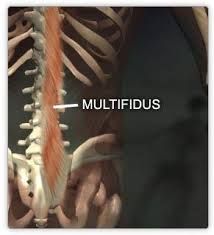
A study several years ago looked at the size of these muscles on MRI scans and compared them to the patient's history of back pain and instability. The researchers found they could predict exactly how much back trouble a patient had by the size and level of muscle degeneration they saw on the MRIs.
So for all the patients that tell me they have no idea why their back went out, here is the most likely reason: Their spinal stabilizer muscles are weak. So what makes these muscles weak and what can we do about it?
What makes these muscles weak is more varied than you think. But let's start with the most obvious. The number one worst thing for good back stabilizer muscle tone is sitting. Humans were never designed to sit. We were designed to squat. When we squat the stabilizer and core abdominal muscles tighten up and stay strong. But when we sit, everything relaxes and the proper alignment of the back joints is gradually lost. As the alignment is lost, the joints pinch and damage the many spinal joints.
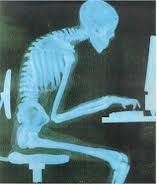
Recent research has shown that the spine can only handle 15 minutes of sitting at a time before the healthy curve of the low back is lost. After 15 minutes it only flexes a mere 7 degrees, but that is enough to increase the pressure on the lumbar discs 250% to 300%. How many of us sit for more than 15 minutes at a time?
Lately I have been telling my patients to get up every 15 minutes and do 5 squats then sit back down. It only takes 15 seconds to do this, but it will reactivate all those core stabilizers muscles for another 15 minutes. The more you can do the squats without holding on to anything, the more stabilizer muscles you will be activating. But if you need to hold on to the desk to start, then do that. But gradually you want to do the squats without holding on to anything. Make the squat as deep as you are able. For many of us just squatting to the point our bottoms touch the chair seat is as deep as we will be able to go at first. That's okay.

The second most common cause for loss of tone in the stabilizer muscles of the low back is something called a viscero-somatic reflex. The viscera refer to your abdominal organs - primarily your intestines, colon, kidneys, and bladder. Anything that causes pain in these organs will also disrupt the function of the stabilizers muscles of the spine. Typically the big muscles that go from the spine through your abdomen to you thighs tighten up and yank the low back toward the navel. This pinches the joints in the low back and they hurt a whole lot. This is usually triggered by distress in the colon. Most people know when their insides are not feeling well, but some people don't feel the gut inflammation, just the back pain that results from it.
The tricky part about this type of back pain is that even though I can relax the muscles and realign the spine, the gut pain will just tighten everything back up within an hour or two. To resolve these kinds of back pain issues, we have to get the gut calmed down first. That means going on a bland soft food diet for a week or two. Avoid any foods that you know bother you and stay away from any scratchy foods like popcorn or raw vegetables. When these bowel issues flare up, your insides are extremely tender and can't deal with any rough or scratchy foods.
The third big cause of spinal instability is stuffed emotions and stress. I try to explain to my patients that stress, fear, and anger does not disappear just because you've shoved them to the back of your mind for the time being. It simply relocates further back in your brain into the areas that control your balance and stability muscles as well as the nerves that control your internal organs. Stress kills. Positive thinking has little to no effect on the brainstem nerve clusters at the back of your brain. These pathways were laid down way before our species learned to think. This is the part of our system that reacts physically to fight, flight, and freeze-threat situations in our lives. The only real resolution comes when we learn the skills to actively engage in what is provoking a threat response in us in a way that creates connection and harmony.
There are dozens of other less likely causes of spine instability like low magnesium levels or food sensitivity reactions, but the real question we are looking at today is how can we decrease the likelihood of one of these causes triggering a bad back?

The answer is good muscle tone. Whatever challenge we have, poor muscle tone greatly increases the chances that it will hit us in the back. The back needs to be strong, not so much flexible. Everyone thinks that when their back is tight that what they need is to stretch out their back. While stretching momentarily makes the tight muscles feel better, it also decreases the stability of the spine. Although no one talks about it, back problems are very common amongst yoga teachers. Forward flexion stretching is not the answer to back problems. Strengthening the back muscles to actually make them tighter is the answer. Some yoga instructors are figuring this out and including a type of yin yoga in their routines that focuses on extending and contracting the back muscles to make them stronger.

For seniors, AARP recommends a very simple core stabilization exercise called the plank. You can't even use the excuse of knee replacements that prevent you from getting down on the floor with this exercise. You can just roll onto your stomach before you get out of bed in the morning to do a plank for a minute or two. The idea is to put your weight on your forearms and toes and lift your midsection up to a straight spine position and hold steady for 1 to 2 minutes. I recently saw a fellow in his mid 50's set a world record by holding a plank position for 1 hour and 22 minutes. If you have very poor tone, you may have to start on just your forearms and knees and hold for as long as you can.
For a more vigorous and therapeutic program of back strengthening, I recommend the Foundation back training program. Inside the pages of this book is a plan that many of my patients are already following. You can get it here.
After a winter of too much sitting, our back muscles have lost a lot of tone. Spring time prompts us to be more active, but with poor muscle tone, simple activities that would normally not bother us suddenly cause back problems. Getting active in building core muscle stabilizer strength is the most useful thing you can do to protect your back.
Take care,
David
Ultrasound Physical Therapy
Now available in the office
Tuesday afternoons and Fridays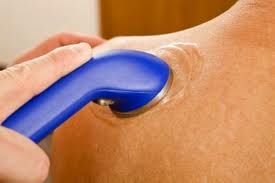
|
H
|
On the Wire
|
Primal Posture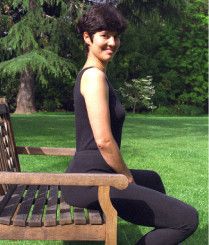
- Esther Gokhale is an expert on healthy posture. The you tube link below is of a TED talk she made last year showing the audience how to sit with good posture to prevent back pain. The simple analogy she uses is to imagine that you had a tail. To sit properly the tail would need to go out behind us, not tucked under us. Check out her video.
Primal Posture
_____________________________________________
"Character cannot be developed in ease and quiet. Only through experience of trial and suffering can the soul be strengthened, ambition inspired, and success achieved."
~ Helen Keller
__________________________________
Dietary guidelines are wrong on saturated fats
It has been 60 years since Ancel Keys first wrote the lipid hypothesis that says that hardening of the arteries comes from eating saturated fats. Unfortunately his theory was a lie. He fudged his study to support his theory by ignoring all the data that said his theory was wrong and only reported the few cases that seemed to support him. Our government in its "quick fix" mentality that tries to control life through stupidly simplistic "just say no" programs grabbed his theory and pushed it to the hilt to the public. Now millions have needlessly died of heart disease by doing exactly the things that promote heart disease - eating a low saturated fat diet filled with carbohydrates and vegetable oils.
"Do not pray for easy lives. Pray to be stronger men."
~ John F. Kennedy
_______________________________
Pups Poop Along North-South Magnetic Lines
Mind blowing facts about bananas Did you know bananas are an amazing health food. In fact the FDA has just allowed the banana industry to claim that eating bananas lowers blood pressure and reduces chances of a stroke. Check out some of the many other benefits of bananas like for anemia, PMS, depression, constipation, heartburn, and more.
"The world breaks everyone, and afterward, some are strong at the broken places."
~ Ernest Hemingway
________________________________________________
Our address is 9725 Fair Oaks Blvd.
Finding
the new location is very easy. Coming from highway 50 up Sunrise Blvd,
you turn left and go up a block. We are on the right hand side - the
building just past the Subway Sandwich shop. If you are coming down
Sunrise from the Mall area then just turn right on Fair Oaks Blvd and up
a block on the right.
If you are coming from the Roseville area you could come down Sunrise Blvd, but that is a long trek. It is probably shorter time wise to come down Auburn Blvd - San Juan Ave like you have been for the Sunset
office, but instead of turning left at Sunset, keep going straight 3
more lights to Fair Oaks Blvd and turn left. Go down 2 lights to New York Ave, go through the intersection, and immediately turn into the turn lane once the center divider ends. We are on the left.
You
are free to reprint this article in your newsletter as long as you
include the following statement in the same size type and color:
"This article appears courtesy of Fair Oaks Health News, offering natural and healthy solutions for body, mind and soul. For a complimentary subscription,
visit http://www.fairoakshealth.com"
|
| |
|
_______________
to check on old newsletters
_______________
About Dr. DeLapp
|
|
Dr. DeLapp has been a philosopher, non-force Chiropractor, medical intuitive, and health innovator for over 30 years. He began experimenting with medical intuition in 1972 while studying physics at UC Davis. In addition to physics he designed and completed an individual major in the philosophy and psychology of education. Shortly after he choose to pursue a career in the only truly health oriented profession available at that time, Chiropractic. He graduated with honors in 1981 with his doctorate and opened a private practice.
Since that time he has continued his research into the effects of consciousness and learning on health.
He developed the Biomagnetic Retraining system for correcting movement abnormalities.
Since 1991 he has focused on developing a powerful system for uncovering and assisting the mind-body connection in health and personal growth. The in-depth coaching, guided by the subconscious direction from the body, is called Heartflow and the simpler mind-body retraining for health and unfoldment he has named Gracework. Both are available at Fair Oaks Health.
Fair Oaks Healing
& Arts Center
Staff
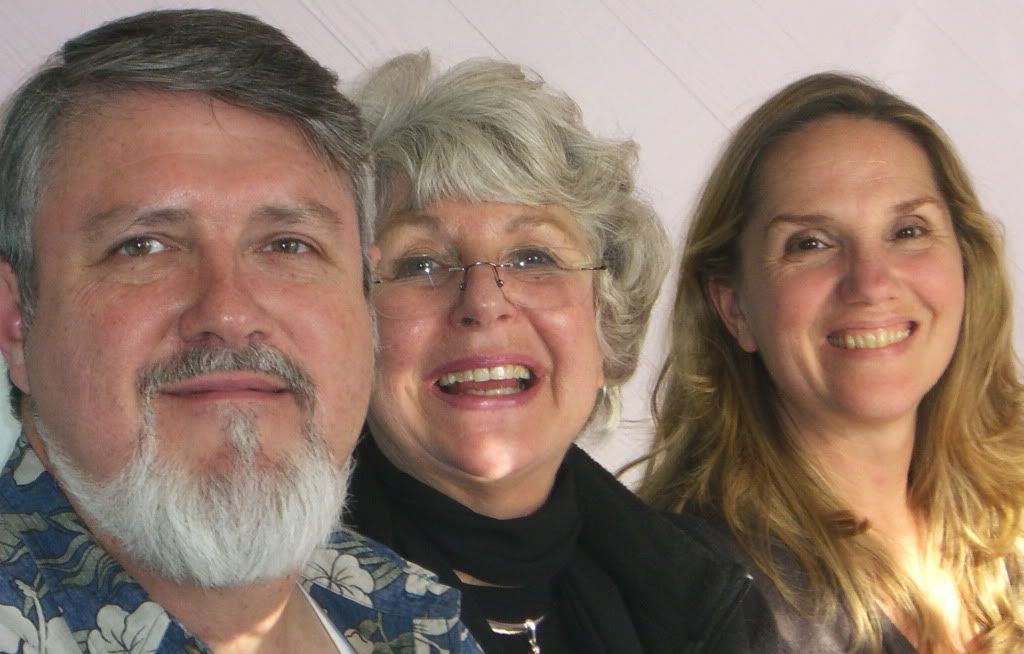
Dr David DeLapp DC
Chiropractor
Ellen Flowers FGM
Spiritual Life CoachEnergetic Nutritionist
Health Care Coordinator
Susan Richardson
Office Manager
Front Desk
Sherry Herrera
Front Desk Person
Hyla Carney
Physical Therapy
Susan McDonald
Catherine Cummings
Is there a sweet that is not poisonous? Yes!
 Dr Dave Supersweet Drops and 2X Sugar Substitute
New Products
Coconut Milk
| |