|
This newsletter is a report about the important functions of cholesterol in the body and why it can go wrong.
February 14,2013
Cholesterol's vital functions
Hi ,
Cholesterol has been given a bad reputation by the medical press. Everyone is being taught to be afraid of cholesterol. We are told to avoid cholesterol in our food and that we would all benefit by being on statin drugs to lower our cholesterol levels in our blood. It has even been suggested and seriously considered to add statin drugs into our water supply much like fluoride.
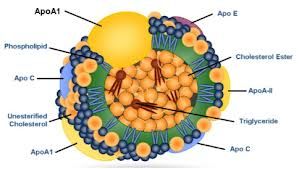
Cholesterol carrying lipoprotein
So what is cholesterol? What does it do and should we actually be afraid of it?
First off, cholesterol is manufactured by our liver to meet our body's needs for cholesterol. Very little comes from our food (less than 10%).
If cholesterol is so dangerous then why is our liver producing it? The answer is disarmingly simple - cholesterol is not dangerous. In fact cholesterol is one of the soldiers in our battle for good health. Let's see how...
1. Every cell wall in our body is made with cholesterol and proteins. Cholesterol is one of the basic building blocks of our body. It is vital for the repair of any damaged cells.
2. Our brain is mostly fat and most of that fat is cholesterol. Cholesterol grows brain synapses so we can remember stuff and function in life.
3. Vitamin D, the main moderator of our immune system, controller of calcium metabolism, essential for blood sugar regulation, and fighter of cancer is made from cholesterol and sunshine.
4. All our hormones are made from cholesterol - sex hormones, stress hormones, and system regulation hormones.
5. Cholesterol is used to make bile acids necessary for the digestion of fats and fat-soluble nutrients.
6. Cholesterol is a powerful antioxidant used to fight free radicals - the burning chemicals that destroy our body from the inside out.
So cholesterol is pretty darn important. It is vital to our health and we need to make a lot of it to survive. So how did it get such a bad reputation?
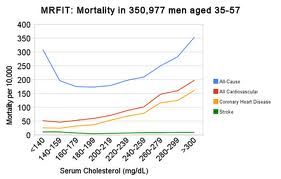
Hindsight would suggest that scientists back in the 50's and 60's just weren't very bright, but they did not have the knowledge of how complicated the body is we have now. It looked like hardening of the arteries was caused by cholesterol clogging things up, so the natural assumption was that cholesterol was bad. We now know that this is untrue - it is not cholesterol but its first cousin oxysterol that is sticking to the artery walls. Big statistical studies were performed that showed increased risk of death when LDL cholesterol levels above 240 were found in patients.
(Note the sudden increase in mortality for cholesterol below 160)
Again the simple assumption was that cholesterol was bad was pushed into the media. No cause-effect relationship was shown, just an association. If you know anything about scientific method, you know that associated findings mean nothing.
In fact, since those early beliefs were formed, the research is showing quite the opposite to be true. This study in the AMA Journal shows no correlation between cholesterol levels and death in those over 50. Further studies have shown that as you get older, the lower your cholesterol levels are the greater your risk of death.
Now lets look at what does mean something. Why do you think your body would start producing more cholesterol than usual? If your body normally produces cholesterol levels of 160 to 180, why would it suddenly jump those levels up to 200, 250, or even 300?
Look back at the chart of all the things cholesterol does. Your body makes more cholesterol because it needs more cholesterol to do one or more of the things in that list. This is why high cholesterol levels are associated with higher risk of death - something really bad is going on that you need more cholesterol to fight. That really bad something is what is killing you, not the cholesterol.
Cholesterol are soldiers - firefighters. When a war is going on more soldiers are called up to fight the battles. High cholesterol levels tell us a war is going on somewhere in the body. They are being called out to repair cell walls, or build more hormones (usually stress hormones), or fight free radicals.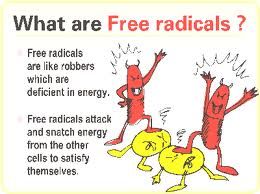
It is this last process that produces the problems with clogging of the arteries. When a cholesterol soldier fights a free radical, it sacrifices itself to destroy the free radical. When this happens the cholesterol is turned into the dangerous substance oxysterol (or oxidized cholesterol). Oxysterol is sticky and it will stick to artery walls if there is inflammation in the artery wall to attract it.
This is not supposed to happen, because the body only uses cholesterol as a last line of defense to fight free radicals once our normal free radical fighters (like glutathione) are all used up. If we have a healthy diet and lifestyle this does not happen. But most of us do not have health diets and lifestyles, so our preferred antioxidant free radical fighters are usually in short supply. So our liver makes cholesterol for that last line of defense in the short run at the expense of damage to our vessels in the long run. The body is like that - always sacrificing our health in the future in order to survive in the present if it has to.
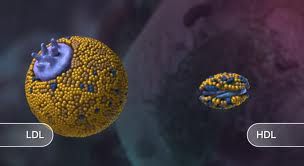
Now you probably have heard of "good cholesterol" HDL, and "bad cholesterol" LDL. These are actually mistakes. HDL and LDL are not cholesterol at all. HDL and LDL are transport busses and ambulances that move cholesterol around the body. LDL moves the soldiers out to the body cells where it is needed and HDL mops up the unneeded and damaged cholesterol to bring it back to the liver for reprocessing. Understanding this you can see why high LDL is considered "bad" - because it means lots of troops are being carried out to battles somewhere in the body. Low HDL is a bad thing because there are not enough ambulances to pick up the unneeded and damaged cholesterol, which leaves it lying around where it can stick to places it does not belong. High HDL is considered protective for heart disease because it means the damaged cholesterol is being transported back to the liver properly.
In truth, all cholesterol is good cholesterol, and the oxidized cholesterol (oxysterol) is in fact the bad cholesterol. HDL and LDL are just transport vehicles for cholesterol.
So now to the big question - is it a good idea to lower high cholesterol? If you have a war going on, would you lower the number of troops you are sending in to fight the battles? High cholesterol definitely tells you something is wrong. Your body would not be making all that extra cholesterol for no reason (except in a rare genetic disorder called hypercholesterolemia). High cholesterol means you have a problem - but the problem is not the high cholesterol, it is something else. If the cholesterol stays high and you do not have enough HDL to mop it up then it will become a 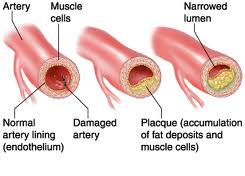 secondary problem for your arteries. But the real and present danger is the inflammatory damage happening right now that is triggering your liver to create more cholesterol to fight that damage. secondary problem for your arteries. But the real and present danger is the inflammatory damage happening right now that is triggering your liver to create more cholesterol to fight that damage.
In my opinion, cholesterol fighting drugs are like sending out street cleaners to keep the neighborhood streets clean while all the houses on the street are burning down. Using drugs is saying "Lets not clog up the streets with firefighter soldiers and ambulances to pick up the wounded."
I think having clean streets is a good thing - clean arteries are important. But by focusing on reducing "bad" cholesterol (LDL transport proteins) you ignore the much more immediate and important needs of the body. Your body needs that cholesterol to fight a serious battle. Pretending there is no battle by reducing the troops makes no sense to me.
Do we want the LDL cholesterol levels to come back down to normal? Of course! But we want them to come back down to normal because we have won the battle and the troops are no longer needed.

How do we do that? I use an anti-inflammatory diet, avoid all sugar, do special exercises that do not over-oxygenate the tissues, avoid toxins in my personal environment, and use anti-inflammatory supplements like Resvero-active, Tumero-active, and Nitric balance.
I hope this makes the cholesterol story clearer.
Take care,
David

How to find us -
Our address is 9725 Fair Oaks Blvd.
If you are coming from the Roseville area you could come down Sunrise Blvd, but that is a long trek. It is probably shorter time wise to come down Auburn Blvd - San Juan Ave like you have been for the Sunset
office, but instead of turning left at Sunset, keep going straight 3
more lights to Fair Oaks Blvd and turn left. Go down 2 lights to New York Ave, go through the intersection, and immediately turn into the turn lane once the center divider ends. We are on the left.
Take care,
David
You
are free to reprint this article in your newsletter as long as you
include the following statement in the same size type and color:
"This article appears courtesy of Fair Oaks Health News, offering natural and healthy solutions for body, mind and soul. For a complimentary subscription,
visit http://www.fairoakshealth.com"
|