|
October 31, 2009
Notice: We will be closed for vacation
November 23 - 27
Fermenting
Hi ,
Well I finally took the plunge. I have been edging up to it for over a year now, but I actually did it last weekend. I pulled out my trusty salad shooter and grabbed my freshly bought organic cabbage, daikon, bok choi, onion, broccoli, cucumbers, and carrots from the farmers market and went to work. Yes, I finally decided to try and make sauerkraut (with a bunch of other veggies thrown in just for fun.) I had purchased a 1 gallon glass jar with a vapor lock in the lid almost a year ago just for this project...but I never got around to the actual veggie shredding until now.
Sauerkraut is amazingly easy to make. In its most basic form it is just cabbage and sea salt. I added a few extra vegetables just to see how they would taste fermented plus added a capsule of my favorite probiotic to "spike" the mix so it would ferment faster. All you really need is just vegetables and salt and a glass or crockery container to put it in.
So what finally prompted me to take the plunge? I was doing some random research (otherwise known as web surfing) on the subject of H. Pylori - the critter that causes stomach ulcers and various other stomach complaints. Half of you out there have it growing in your stomachs this very moment. I came across a scientific study that showed sauerkraut gets rid of H. Pylori. "Cool" I thought, "why take a lot of expensive herbs or drugs when a natural food will do the job?"
Some form of fermented vegetables or other products are a part of the daily diet of almost every culture on earth. Fermentation and drying were the very first forms of food preservation. A fresh cabbage will go rotten at room temperature fairly quickly, but fermented it will last many months. As such, fermented foods are a major foodstuff during the winter and early spring in most cultures. Cabbage is high in vitamin C and so is the sauerkraut made from it (it was barrels of sauerkraut that allowed Captain Cook's sailors to sail around the world without getting scurvy.) So I finally decided that I had to try this traditional food.
How the process works is that anything grown in healthy natural soil (meaning not soil filled with chemical fertilizers and pesticides) will get covered with healthy probiotic homeostatic soil organisms - HSO's. They form that white film you find on the outside of these foods that we often try to wipe off. Don't wash this off as it is part of the healthy benefit from organic foods. These organisms help protect the plant much the same way as the layer of acid forming bacteria covering our skin protects us from negative bacteria (which is why it is a bad idea to wash your hands with antibiotic soap - it kills off your protective good bacteria.) By eating these bacteria they line our guts and protect our insides from bad bacteria
- like the H. Pylori I mentioned earlier. Plants raised in chemically treated soils don't ferment well - they tend to rot rather than ferment...kind of like our guts do with all the chemicals we dump into them from our so called convenience foods.
Well all you need to do is mash the vegetables in some way to break the cell walls so the good bacteria can grow on these nutrients and form lactic acid (as a by product) which will preserve the food. Lactic acid inhibits the growth of negative bacteria. When the process is first starting you need to give the right bacteria a growth advantage over similar competing bacteria that are not the ones we want to grow. That is what the salt is for. Most of the bacteria we don't want don't like salt but the good guys don't mind it. The only exception is a family of slime that is salt tolerant, but they need lots of air so we seal the vegetables and good bacteria away from air and give them enough salt that only the good bacteria grow and ferment our veggies.
So here I am with my farm
fresh garden vegetables chopping, slicing and shredding. I then toss in a little good sea salt (regular commercial salt contains toxic chemicals that can kill the good guys - you might think of that the next time you put it on your French fries.) I give everything a chopping, slicing and shredding. I then toss in a little good sea salt (regular commercial salt contains toxic chemicals that can kill the good guys - you might think of that the next time you put it on your French fries.) I give everything a  good crushing squeeze, which makes the plant juice come out forming a brine. I break open a capsule of probiotic with HSO's and mix it in then tightly pack all the wet mix into my glass jar to the top. I make sure the brine good crushing squeeze, which makes the plant juice come out forming a brine. I break open a capsule of probiotic with HSO's and mix it in then tightly pack all the wet mix into my glass jar to the top. I make sure the brine 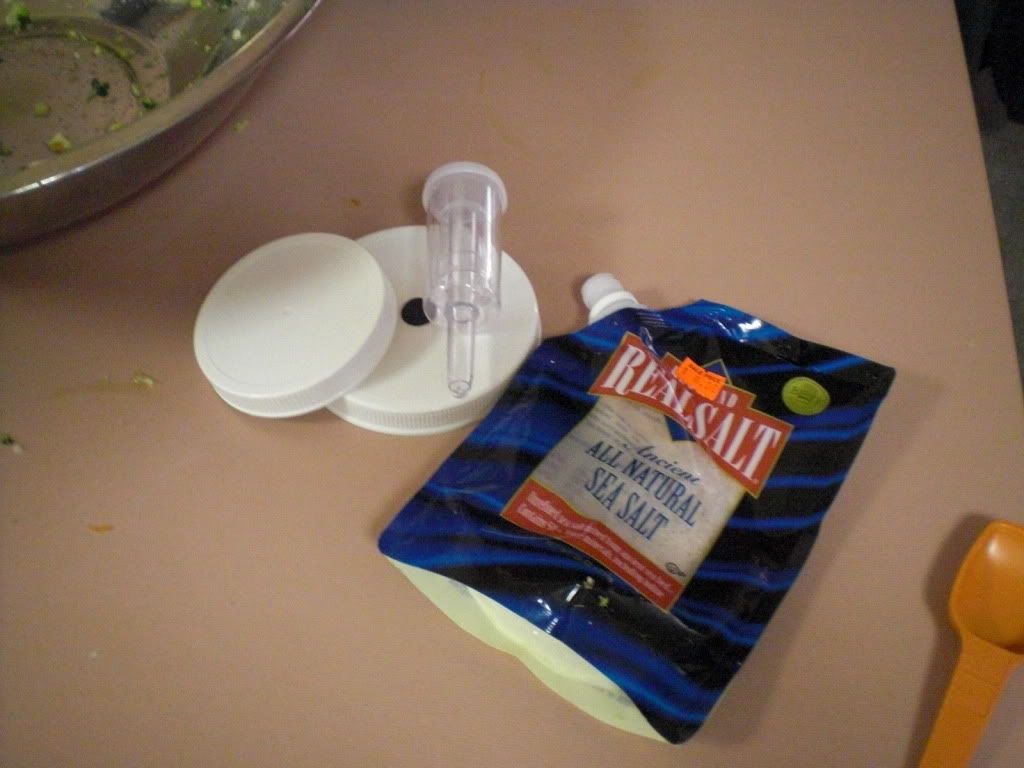 covers the veggie mix by putting an inverted smaller jar lid over the top of the veggies then screw on the cap to the jar. The idea is to seal out all the air. This cap has a hole in the top to fit an air lock into, which will allow CO2 gas to covers the veggie mix by putting an inverted smaller jar lid over the top of the veggies then screw on the cap to the jar. The idea is to seal out all the air. This cap has a hole in the top to fit an air lock into, which will allow CO2 gas to  escape without letting any air in. Fermentation produces gas just like in beer or champagne. I set the jar in a cake pan to catch any escaping juices in a dark corner of the kitchen and just let it be. 36 hours later I have escape without letting any air in. Fermentation produces gas just like in beer or champagne. I set the jar in a cake pan to catch any escaping juices in a dark corner of the kitchen and just let it be. 36 hours later I have 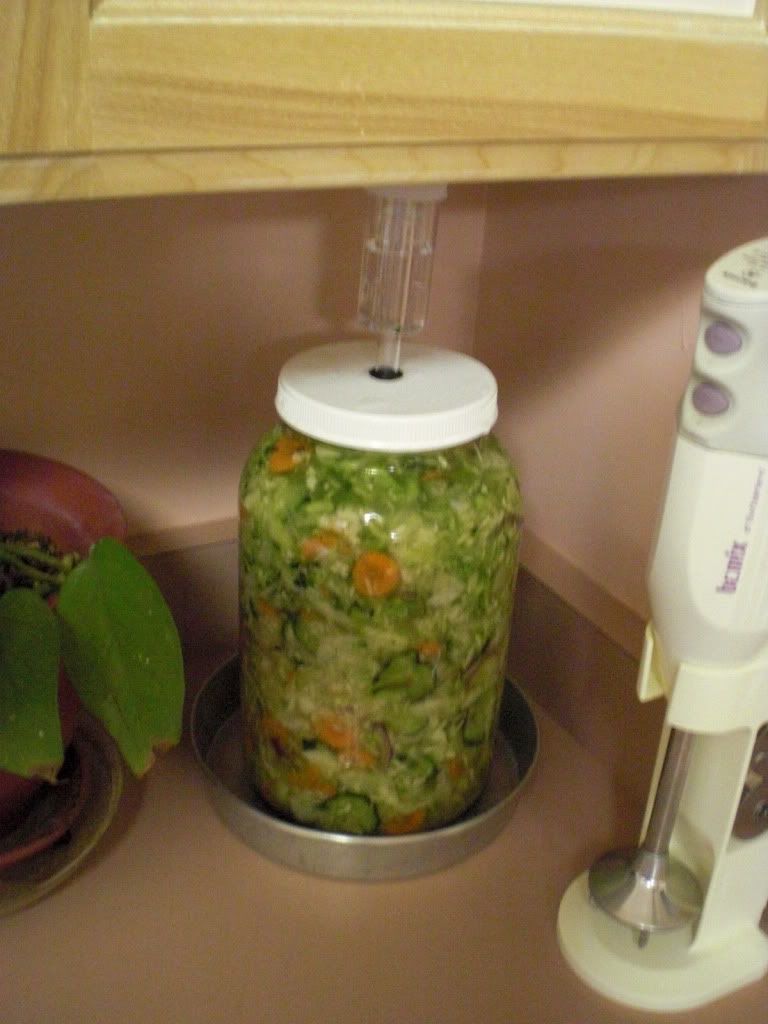 sauerkraut! sauerkraut!
On tasting it I think I will leave out the bok choi tops and the broccoli as they seem a bit bitter to me. The rest is great. My goal is now to have a little every day to help build a happy tummy. I can put all kinds of fun herbs and spices in later batches like garlic and cayenne to make Korean Kimchi, or asian spices for an asian salad taste. If you want to really do something good for your insides, make yourself a nice batch of sauerkraut and have a little every day.
Bonus: as this issue was going to press Dr. Mercola had a nice article on fermenting today in his newsletter. For more good information go here:
Good Journey,
David
Get Your Health Action Plan Outline Here CLICK HERE
Health Challenge #19
Muscles: Doing More to Keep Up
Your body is very energy efficient. Any tissue that burns a lot of energy that you are not using, your body will break down and use it elsewhere. Muscles use a lot of energy just sitting there. Consequently your body is always keeping track of just how much you use and need your muscle mass and getting rid of any excess. (Too bad it doesn't do that for fat.) How does your body know how much muscle you need? It measures just how much microtrauma takes place in your muscles. When you push a muscle to its limit and ask it to do more than it can, little micro tears occur in the muscle. When this happens, the body says, "we need more muscle" and proceeds to build more. When the chemical messengers that are released with this trauma stop being released your body figures it has plenty of muscle and starts tearing it down. This teeter-tooter balance between 'no enough' and 'too much' is what physiologists call homeostasis. Homeostasis (balance) means health to the body.
One extra piece is needed in this puzzle. The stress hormone cortisol suppresses muscle building. That means that too much muscle stress from too much microtrauma actually stops muscle building. So...
How to build muscle strength:
To build muscle mass and strength you have to push your muscles to do more than they are capable of just long enough to produce a little bit of microtrauma but not too much.
For average people that looks like this. Contract or extend the muscle you want to build against resistance. The amount of resistance should be just enough to push the muscle to failure somewhere between the 7th and 12th push.
When I say "push to failure" what I mean is that as you are pushing your muscle just can't push any longer or further. It will start to tremble and then begin to fail. For average people pushing to failure just once with each muscle group twice a week is all that is needed. The muscle needs a couple of days to rebuild after the microtrauma and it needs proper nutrition to rebuild with. Muscles are made of amino acids and need them to repair themselves. It has been found that the optimal time to flood the system with good amino acids from protein is about 15 minutes after the workout...so have a nice protein shake after your workout.
Your whole muscle building workout might only take 20 minutes twice a week. Alternate muscle building with another 20 minutes twice a week doing interval training for lung capacity and cardiovascular tone and you have the some of the best health insurance you can get.
Dr. Dave
If you missed any of the previous health challenges -
 Special Offer: Free Health Evaluation
Discover your true health status Special Offer: Free Health Evaluation
Discover your true health status
________
You are free to reprint this article in your newsletter as long as you include the following statement in the same size type and color:
"This article appears courtesy of Fair Oaks Health News, offering natural and healthy solutions for body, mind and soul. For a complimentary subscription,
visit http://www.fairoakshealth.com"
Trim Challenge:
I am working at keeping the carbs down plus getting rid of dairy products and dropping down fruit. I think I need to get back to the gym more regularly to reduce my tendency to eat unnecessarily. Getting a new focus to replace eating as a means of generating comfort is a good way to shift old patterns. Just trying to suppress old patterns does not work. They win out in the end. The pattern needs to be replaced with something that fills the need but that is in better alignment with where you want to go. Will the gym fill those same needs? We will see.
David
Announcing a new service at Fair Oaks Healing Arts
Wouldn't it be great if you had someone to hand walk you through the transition to a healthy lifestyle? to hand walk you through the transition to a healthy lifestyle?
Find out more here:
FOHAC Healthy Lifestyle Support Services
Ouestions - if you have questions of a health or growth nature we could discuss in this newsletter, or if you have comments or ideas about a future newsletter focus please email me at:
david@fairoakshealth.com
|